Saturday, 23 January 2016

Doggie Treats.

Phoenix has always been a fussy eater  -  apart from his two meals of rice, milk and chicken, he does not eat any of the snacks like biscuits or toasts that the other dogs enjoy.  He looks mournfully at them crunching up the tidbits, but refuses to have them himself. 

Phoenix as a little pup


The only snack that he ever enjoys and begs for is the ‘chewstick’.   Now this is a doggie treat that all of them love, but it is something that is not available in Chitrapur or its vicinity. So our Mumbai trips always have a visit to the petshop where we buy enough to last us until our next trip.  And still sometimes that is not enough!  

No, thanks, I don't eat human-biscuits


We can never sneak one out of the packet and give only Phoenix when the others are munching their share of human-biscuits. Oh,no – for Phoenix refuses to eat one all by himself. He waits till everyone is around  and then takes his. It may seem strange especially since most dogs just grab the treats. But not Phoenix – he is the gentle one, he likes to share his treats! 


A couple of months back, we ran out of chew-sticks way before our trip to the city.  And Phoenix’s expression became so mournful, that I did not even venture near my bookshelf. The bookshelf ?   Yes, the packet of chewsticks is always kept on the top shelf of our bookshelf for easy access.  You just have to step near it and Phoenix is there right behind you looking hopefully for a treat.


We had a visitor the other day and when I went in to get some tea, he wandered around and stood in front of the bookshelf looking at the collection. Something in the top shelf caught his attention and he started taking out the book when he sensed some activity behind him. He turned around to see four dogs gathered around him watching his every move and he froze. I walked out with the tea just then and seeing his  expression burst out laughing.  “Have you trained the dogs so that no one can touch your books?”,  he asked. He had a hearty laugh too when I told him about the chewsticks!
So you can imagine how it is when we exhaust our supply of chewsticks. 


Sigh.....this is how it feels to have a chewstick-less existence
I had to do something and thought of making some doggie biscuits at home. A couple of eggs mixed directly into whole wheat flour (no unhealthy refined flour for my darlings you see), and a dough mixed together with chicken stock.  I shaped it into a log, sliced it into biscuits and baked them.  


D-shaped Doggie biscuits - just so that the humans know whom it is meant for


They were tough to break, since I had not used any baking soda. Now the real test – would Phoenix eat them?  I called out to all of them and they came obediently into the kitchen. I handed out the first one to Phoenix, he sniffed at it, thought for a moment, looked around to make sure that all the others were also there and then accepted it delicately.  

It sure smells good, guess there is no harm in tasting it.


Hurrah!  He carried it out to his favourite chair, and sat and ate it and was back for more!  Hurrah indeed! 
So now I have home-made doggie treats for our canine quartet!


Thursday, 24 December 2015

Hisssssss............Hibernation Hassles!

The room is dark and cool.  It looks like no one has been in for quite some time. I make my way inside and look around for a decent place to snuggle into.  There seems to be none, the room is bare except for a cloth covered thing kept vertically in the corner. 


  I explore around and find a perfect opening for me to slide into. There is a large round smooth surface, beyond which there is a long bar with cold, thin metal strips across it.


But the metallic strips are smooth and I make my way to the top. Just as I wrap myself around the wooden bar for my snoozy, the whole thing tilts and tips over.

But I am too sleepy to bother and I snuggle into the perfectly comfortable position and a dull, lethargic feeling washes over me and soon I float away into dreamland.

I have no idea how many hours or days I have slept, but suddenly there are voices right in this very room. A harsh light is switched on, and footsteps approach me rapidly.


“Oh, no, the sitar has fallen...  how could it,.... this is not the way I had kept it,  oh no.....” a woman’s voice cries.


 The man replies “Oh I must have kept it down when I was fixing the light in this corner”

“But this is not the way to keep it,  no it has fallen over..” and gentle hands grasp the very bar on which I have wound myself and turn it over.

I jerk out of the way.

“Oops, there is something inside, looks like a frog has got in”.

 Oh woman!  Mistaking me, for my very own meal.

“Oh is it? I’ll  get him out” and the cover is being opened.

Oh what nerve!

 The light shines right thru and looks like I have no place to hide.

“Wait, don’t just open it, check whether it really is a frog”
“Yeah I’m doing just that”
“No, don’t!  Just feel it from outside” and the woman actually pats me!

Oh what cheek.

“Doesn’t feel like a frog”

Now the man walks over and pats around.  I hiss.

“Was that a hiss?”

Oh these humans!  How loud does one have to hiss for them to know that it is actually a hiss!

 And I am being patted again!  Now I hiss real loud.

“Oh yes there is a snake in there”  the man says. 

“Let it be, leave it alone, it must have been resting”...  Some sense finally!

“Wonder which one it is. May be if we wait, it might crawl out”........Oh really?

“It is already too late now, we’ve got to be up early tomorrow, and it is Ok if I don’t loosen the sitar strings for a week. We can check whether it is still inside after we return”.......Oh you bet!  

Thankfully they switch off the lights, and go away leaving me alone in the comfortable darkness. Looks like I have a whole week of peace and quiet, now. So I better get back to catching up on my glorious beauty sssssssleeeeeeep.


p.s.  When we returned after a week, Mr. Hisser was still hibernating inside the cloth cover of the sitar.  We carried the whole thing out into the bushes and gently opened the knot. The snake slid out and vanished into the greenery at an astonishing speed.    

Wednesday, 25 November 2015

Jaggery Jaggery


After having heard umpteen stories from old-timers about a long gone era, when they used to walk all the way to our farm to spend an afternoon watching jaggery being made.

Jaggery being made on this farm.....?

The original owner used to grow  a patch of sugar cane exclusively for making jaggery.   This must have been some 40 years ago, the sugar cane juice would be extracted by bull-power  - two bullocks pulling the contraption in a circular path, the juice then being condensed on a wood fire to prepare jaggery.  No chemicals, no bleaching agents, no solidifiers, no preservatives – just pure sugarcane juice.  An astounding process!  I was very curious and wish I could go back in time to see this.  Was this method still followed anywhere?  – but all my queries met with the same answer – “No one does it any more here in this village.  If you are lucky you might find some one in the smaller remote villages who does it...but no idea where...”.

And as luck would have it, our farmer friend Sonnu, turned up the other day with a small gift for us. It was a ball of hand-made jaggery – yes the same kind that used to be made years ago on our farm!  He patiently answered our questions and offered to take us to the village if we wished. So a date was fixed and we met him at his farm which is about  7 kms away. The village was quite remote and had no motorable access to it so we would have to walk.  The route took us through a path quite similar to our Hudil trip although not as long. 

 
Full many a flower is born to blush unseen.......


A part of the route through an areca plantation

 We soon came upon a clearing under a huge tree where a group of villagers seemed to be having a picnic of sorts.  Laughter and merry chatter and a sweet smell wafted over the air as we made our way to the clearing. 
The Juice extraction press was placed on a wooden slab next to a small pit with a drum in it. Two placid looking bull-buffaloes were going around in circles pulling the shaft of the juicer while one young boy was expertly pushing the cane into the juicer. 


The juice flowed swiftly into the drum.  On the other side was a massive ‘choolah’ on which a giant copper vessel contained a bubbling liquid.


  Two young men wielded giant copper spatulas with which they swirled the frothy liquid, continuously, not giving it a chance to stick to the pan. This batch of jaggery was almost near completion and we were lucky, we could see the last and the trickiest part of the process. When   the precise consistency was reached, the men put a stout bamboo through the two handles of the huge pan and hoisted it over their shoulders like a palanquin, carefully making their way around the choolah, placed the pan with its still bubbling contents on the ground.


The copper spatula cleaned and kept up on this natural shelf


The copper spatulas were kept aside and a wooden device -  a long handle attached to a  flat bar of wood was used to stir the fast thickening contents. The movements of the two men who were stirring the contents were so brisk and swift, the jaggery which would start crystallising around the edges was whisked into the middle in a flash.  I tried my hand at it – don’t we do a very similar thing when making mysore-pak at home?  But the sheer volume and size dwarfed my efforts and I found the jaggery crystallising on the edges faster than I could handle. I quickly handed over the wooden device back, lest the texture of the jaggery get ruined.  Finally the mixture started lumping in the centre and the gleaming copper vessel shone through.


 By now one group had gathered around the copper vessel with containers of cold water. Two huge coconuts with husk intact were used to smoothen out the hardened lumps.


 This hot, fast hardening lump needed to be shaped into even sized balls.  Everyone got busy, dipping their hands into the cold water and taking a lump of the smoothened mixture  expertly shaping  it into balls


 Another group had assembled around a clean sheet at the head of which one man was sitting with a small weighing scale. Each ball was weighed, adjusted and reshaped to make   it the perfect size and then placed neatly on the cloth.


   Soon all the balls were made ready and it was time to re-ignite the choolah and place the giant vessel back on to it. 


By now a sizable quantity of cane had been pressed and the drum was full of freshly extracted juice. Some of it was poured out into glasses and passed around for us to drink, and then the rest was emptied into the copper vessel. Approximately a whopping hundred and forty litres of juice was poured into it.


The fire was blazing away and the mixture soon started bubbling.  It would not need so much attention now, so most of them wended their way down to the sugarcane field to cut down enough cane for yet another batch of jaggery.

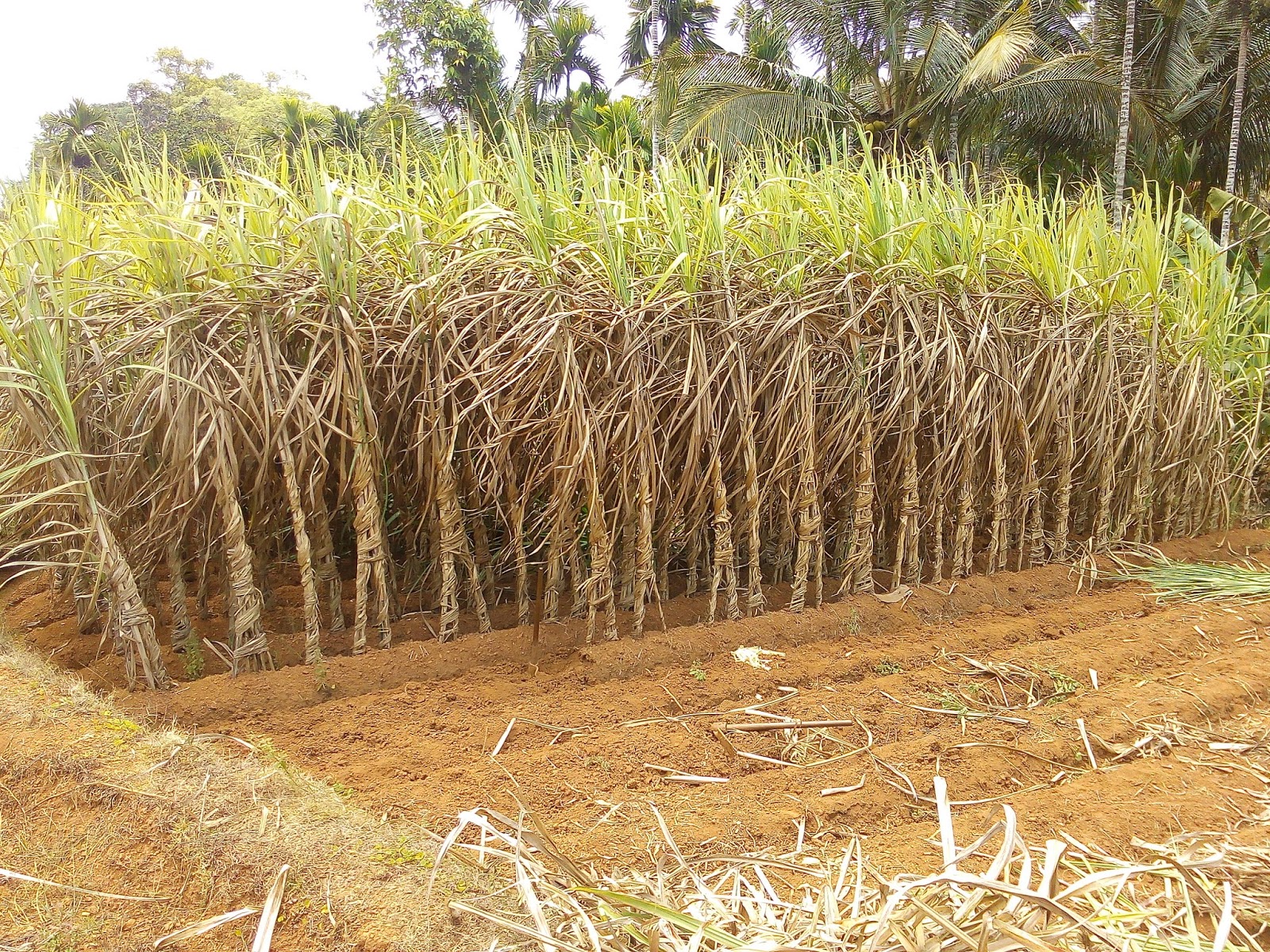
Yet another batch of sugarcane waiting to be harvested


It was also time for us to get back to the farm, so we left the little clearing and retraced our way back to return home, carrying with us a load of freshly made pure organic jaggery.

And yes, it is a new addition to our online store as well  www.hulidevana.in


Sunday, 25 October 2015

Bhairav falls into a well.

It’s been two days since Bhairav has not returned home with the rest of the gang.  He is still too young to play truant like his older ‘cousin’ Balaram who is now two and half years and already a young bull. So whilst we are not unduly worried when Balaram does not return home for a day or two, we were concerned about Bhairav.

  Manjunath searched for him on both the days with no luck.  On the third day, he arrived looking rather tense – “Bhairav has fallen into a well”  he said.  Oh no! What kind of well – fully or partially dug? Was there no embankment? How deep?  How much water is there?  My questions tumbled out before he could answer even the first.  “It is a dry well and not too deep” he answered.  Oh no!  A fall onto hard ground could mean broken bones.  I was almost in tears, but Manjunath assured us that he wasn’t hurt.

 We rushed to get a good length of strong rope from the boot of our car, Manjunath hauled the ladder onto his shoulders and led the way across the fields which were now dry post the rice harvest.  Some  had the rice stubble in them and some of them had been ploughed for a second crop.  From a distance, the fields look so perfectly level, you feel you can run over them, but the stubble, the upturned clods, the narrow embankments made it impossible to even keep pace with Manjunath and Revathi who had joined in to lend a hand.   They walked briskly – it is a similar path that they walk every day from their home to our farm.
Manjunath and Revathi leading the way.  


We soon came to a clump of bushes and Manjunath set the ladder down. I was looking all around for a well when I realised that the clump of bushes itself was growing out of the well.  A perfectly camouflaged natural ‘trap’! 

Would you believe this clump of shrubs is concealing a well?


  I could not see anything in the dark depths, but when I called out to Bhairav, his plaintive voice echoed out and I could see his eyes gleam as he raised his head to look up at us. 


Manjunath got busy wielding his sickle and cleared out a place so that the ladder could be lowered and he could climb down.   


Our 20 feet folding ladder was luckily long enough to just reach the bottom of the well. That meant Bhairav had fallen to a depth of 20 feet!! It was just the dense growth of shrubs in the well that had saved him.  But I couldn’t be sure he was perfectly okay till I could see him properly.


By now Manjunath had climbed down and Vivek had lowered the rope into the well.  Mahaveer, who was working in his field nearby came to assist us.


 Manjunath tied the rope around Bhairav’s belly like a harness and Bhairav panicked. He had never had a harness around his middle ever and this was too much for a frightened, starving guy to bear!  He went crazily in circles in the closed confines of the well, the ladder started toppling over and we were worried about Manjunath. 


But luckily he paused for a while and Manjunath untangled the rope from around the ladder and swiftly climbed out. The ladder was hauled out before Bhairav decided to run a few more crazy circles. Now the need for brute strength!    Four pairs of hands hauled the ropes up and a kicking, protesting Bhairav was dragged out of the well. 


We had to hold him down to undo the makeshift harness of ropes and barely was the last one removed when he broke free and tried to run. 


  In all the excitement I just realised that he was perfectly fine – no broken bones – just a terribly hungry, thirsty young bull with a mightily bruised ego! He almost ran all the way back home, back to the safety of the cow shed where an extra large bucket of feed and a pile of freshly cut fodder  awaited him.  


Back home finally!

Thursday, 2 July 2015

Green & Red...Black & White


Green and Red! 

Black and White!

...... Guess what I am talking about? 


Traffic signals and newspapers....?

Pshychedelic lights and Old photographs......?

Ha ha, none of the above.  This post is about the world’s most traded spice, the king of spices – Black Pepper. 


Once known as ‘Black Gold’ , pepper was used as currency  during the Roman Empire.  The elite Romans had acquired a taste for this tongue-tingling spice and ships laden with pepper would sail the seas from the Malabar coast of India, traverse some part of the route by land and finally reach the great Empire of Rome.

Apparently the Roman Philospher ‘Pliny the Elder’ has been documented to have complained that there is no year in which India does not drain the Roman Empire of fifty million sesterces!  WOW That must have been  a lot of money in those days!


The first pepper season after we moved to the  farm was indeed very exciting for us.  We watched with awe as the pepper plants flowered – thin, delicate looking white flowers that ultimately grow into the beautiful green berries.  
Delicate Pepper Inflorescence
Tender green pepper
We feasted on tender green pepper in brine and waited eagerly for ‘Harvest day’.  How do you decide when exactly is the pepper ready for harvest?  Well the green berries actually start ripening on the vine and turn a brilliant attractive red.  And when a few of them on each plant start ripening, you know it is time to harvest them. The berries are clumped around a central stem and the entire clump is called a ‘Spike’.  Each pepper vine bears anything between 10 to probably a 500 spikes depending on the age and health of the plant. Each spike of pepper is hand plucked into a basket. A precise tug in the right direction is what is needed. I ended up breaking parts of the vine initially, got my nails all dirtied trying to snip it off with my thumbnail, wasted a lot of time trying to use a cutter, while Vivek and our farm hand  steadily worked their way up their ladders, their baskets filling up with green and red spikes of pepper. 


So each day in the second fortnight of January, our front yard has heaps of the pepper berries. The next task is separating the berries from the central stem. The traditional method of stamping them with bare feet is the tried and tested and quickest way to do it. The red berries are to be separated by hand first and then the spikes are placed in a large sacking on which one has to trample around.  Easy though it looks, it is quite a task!

Those berries that have turned red, are squishy soft, but with a hard centre seed. This hard centre seed is the exotic ‘White pepper’   used in French and other continental cuisine. So once the reds are  separated, they are  soaked in water overnight.  Next day  a brisk rubbing and several washes later the seeds are ready to be  sun-dried to get  good quality white pepper. So that is how the reds turn to white!

White Pepper


     As for the rest of the green berries, the trampling action separated most of the berries from the spikes.  The spikes are separated out and the berries are subjected to a hot water soak for a few minutes, drained and the  sun-dried to turn them into the wrinkled ‘black pepper of commerce’.  And that is how green turns to black!


The hot water soaking also  helps to remove any impurities, bits of the stem etc. So then, the  last task is to separate the very small pepper – from the regular sized ones. We do this with a sieve, and the small ones, small they may be, but they sure pack a punch, are stored separately to turn into fragrant pepper powder whenever we need.

And the medicinal benefits of pepper are surely worth a mention.  It aids digestion, has anti-inflammatory properties, contains anti-oxidants and helps clear a runny nose and sore throat.

Here is a simple recipe for a herbal tea (Kashaya) which works wonders on a runny nose and sore throat –

One small onion (preferably white) sliced lengthwise.

3-4 Tulsi leaves.

2-3 Ova leaves.

A small piece of ginger crushed.

A pinch of turmeric.

3-4 Black peppercorns freshly crushed

A small lump of jaggery.

Boil all the above ingredients in a cup of  water until reduced to 3/4th cup. Drink it hot.


And remember the active ingredient – the health benefitting essential oil – piperine is volatile, so store your peppers in airtight bottles and as far as possible, use freshly ground pepper.

So the next time you reach out for pepper to add to your cooking, remember the myriad benefits of this little seed!
Visit BlogAdda.com to discover Indian blogs